
Parametric models · practical guides
Test fit before the full print
A coupon helps you compare candidate clearances. It cannot predict a successful fit for every material, orientation, load, or printer.
Download these original sample files directly. Creating models, checking files and AI edits in PurCad use the credit terms shown before each paid action.
Files
Open the SCAD workspace, upload model.scad as the main source, change a parameter and compile. Compare the dimensions, then download the STL from that successful build.
Download these original sample files directly. Creating models, checking files and AI edits in PurCad use the credit terms shown before each paid action.
Parameters to check
| Parameter | Value | Checked endpoint values |
|---|---|---|
nominal_diameter | 8 mm | 4 / 16 |
candidate_clearance | 0.2 mm | 0 / 0.6 |
coupon_thickness | 4 mm | 2.4 / 6 |
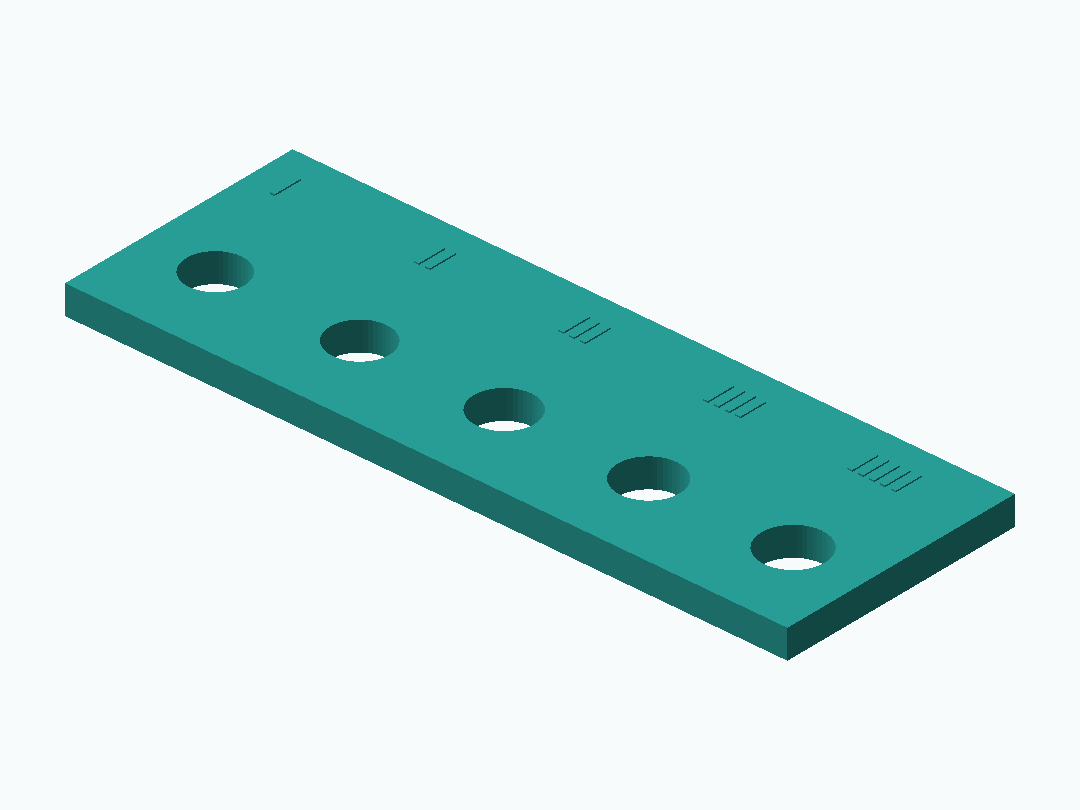
Read the five marked test holes
Count the embossed tally marks from left to right. Clearance below is radial: it is added on each side of the nominal diameter. Record the actual printed hole dimensions before choosing a value for a mating part.
| Tally marks | Radial clearance, mm | CAD hole diameter, mm |
|---|---|---|
| 1 | 0 | 8 |
| 2 | 0.1 | 8.2 |
| 3 | 0.2 | 8.4 |
| 4 | 0.3 | 8.6 |
| 5 | 0.4 | 8.8 |
Geometry evidence
Model file bounds, including any arranged parts: 100 × 35 × 4.2 mm.
A displayed model and its dimensions are geometry evidence, not proof of physical fit, strength, electrical clearance, or print success.
Build measurements (JSON)State the mating requirement
Describe whether the pair should slide, press, hinge, or locate. Record the nominal dimensions, material, orientation, and printer settings beside each candidate.
Measure and revise
Print the coupon, measure the actual features, and record the result before changing a full model. Keep the mating features independent instead of scaling both parts together.
Questions this page answers
What clearance should I use for a snug or sliding fit?
Use a coupon with several labeled candidates and measure the result on your printer. This page does not prescribe one universal clearance.
Why do printed holes come out undersized?
Internal openings can print smaller than CAD due to the process and settings. Measure a coupon and revise the bore or clearance parameter deliberately.
How do I tune a lid or dowel without scaling the mating part?
Change the relevant clearance or mating feature in source geometry, then rebuild and test. Whole-model scaling changes dimensions you may need to preserve.
Can I print a small test before printing the whole enclosure?
Yes. A small coupon can isolate a lid, bore, or dowel interface and reduce the cost of a revision, but it is not proof of full-part performance.