
Workflow
Validate AI-generated CAD against its prompt and built geometry
Check whether an AI-generated CAD model contains the requested holes, dimensions and connected geometry. PurCad combines requirement checks with OCCT geometry checks; review those findings alongside assumptions, sections and measurements before downloading.
Check the claims that matter before a handoff
- List required holes, counts, centers, dimensions, body count, and minimum wall values.
- Mark any assumed measurement or unverified load condition for human review.
- Inspect sections at fasteners and mating surfaces, then keep the selected version with the report.
Define what success means before generation
Critical holes, fastener counts, clearances, overall limits and component relationships should be explicit in the request. PurCad extracts these obligations and compares them with the authored design and available kernel evidence.
Build real geometry and collect facts
The geometry worker produces B-Rep evidence, overall bounds, component facts and feature-effect checks. Validation combines these results with DesignIR intent instead of relying only on what the model said it created.
Resolve blockers and read every assumption
A failed check blocks export. Warnings and risk categories remain visible even when geometry passes. Review values derived from defaults, confirm fastener fit and inspect disconnected-body or missing-feature evidence before preparing files.
Validation is not engineering certification
PurCad can verify bounded geometric claims; it cannot certify fatigue life, material quality, fire safety or regulatory compliance. Safety-critical, rotating, suspended and human-supporting parts need qualified analysis and physical testing.
Inspect an existing PurCad project
The 40-tooth chainring case records its dimensions, OCCT geometry checks and versioned exports. It is a CAD concept, not a proven riding component.
Read the case study (English)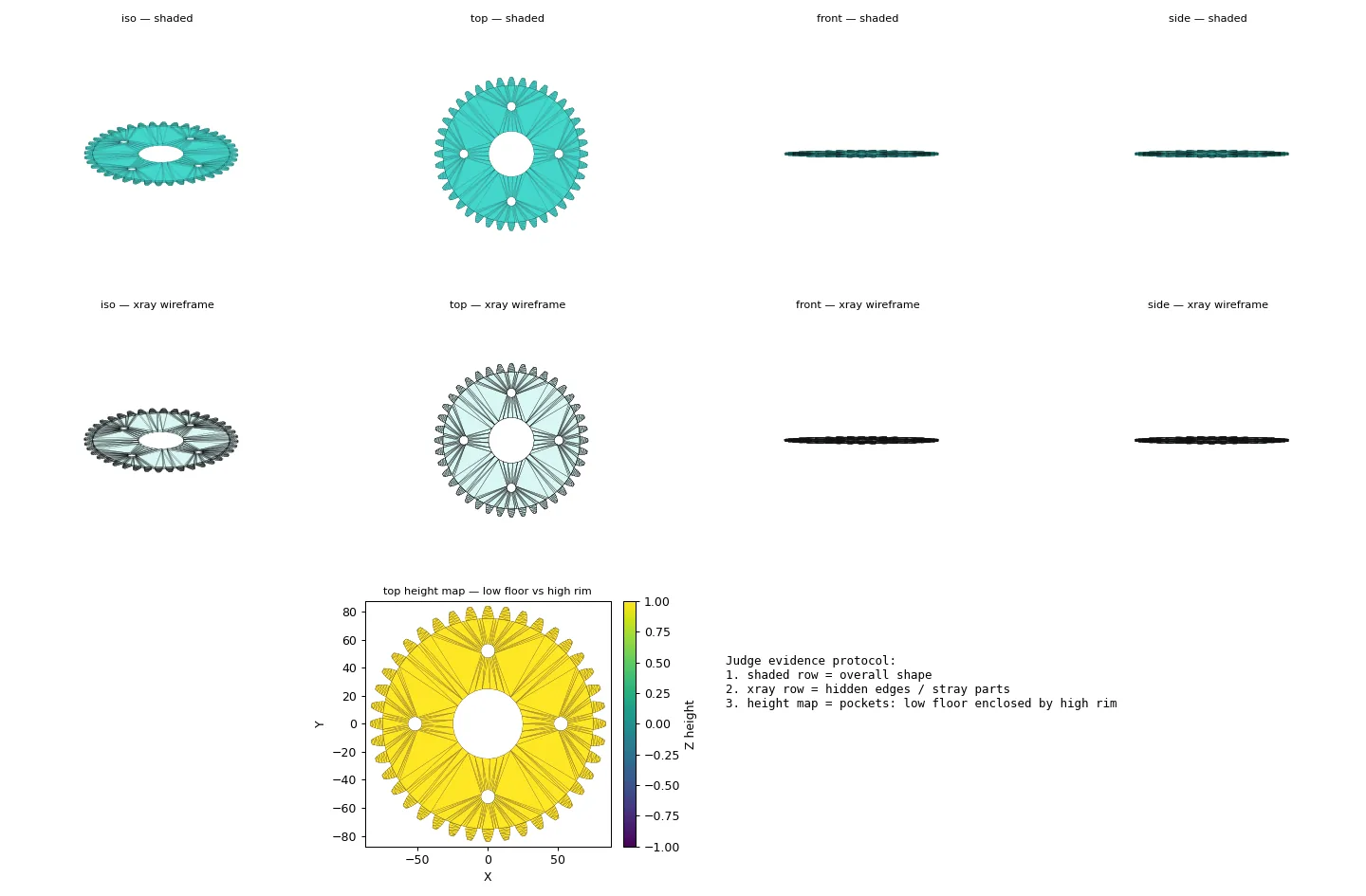
Practical questions
What does PurCad validate in AI-generated CAD?
PurCad’s Check panel analyzes CAD generated inside the PurCad project against recorded requirements and built geometry facts. It reports bounded checks and assumptions; it does not analyze arbitrary imported or reconstructed CAD.
Does a valid CAD solid guarantee a printable part?
No. A connected solid can still be too thin, poorly oriented, or dimensionally wrong for the printer and material. Use slicer inspection and a physical fit test where failure matters.